

THE SHOAH. GHETTO. FIRING SQUAD

Updated: Jun 7, 2021
During the interwar years, there were about 620 Jews in Derazhne, who made up 90% of the total population. At that time the Jews were still engaged in trade and small-scale industry, also they owned three mills and a brick factory. With the beginning of World War II, the situation changed significantly. The Nazis occupied Derazhne on June 28, 1941, and immediately created the German military commandant's office, which controlled the village. During the summer and autumn of 1941, the German occupation authorities introduced many anti-Jewish measures. Jews, that reached the age of 14, were forced to wear stripes or armbands with the Star of David to identify their nationality. Evasion from wearing a special sign was punishable.

Curfews were also among the restrictions that imposed on the lives of Jews. The life of the Jews became increasingly unbearable. The invaders ordered to give away all the gold and valuables. They also selected clothes, sorted and sold them through a retail network. Shops held by Jews also were confiscated by the invaders.
On October 5, 1941, a ghetto was established on the territory of the Jewish city quarter, which consisted of 8 houses in the centre of the village.
According to historical sources, ghettos were created in the most abandoned parts of the towns. Their small size and tiny housing stock led to a catastrophic shortage of housing. On average, there were 1-2 square meters per person. The place of captivity was surrounded by a wooden fence with barbed wire, guarded by the police. However, according to one of those who managed to survive in those days, the ghetto in Derazhne was not fenced so Jews could move freely. There were approximately 1.8-2 thousand Jewish people from the city itself and the Derazhne district. The "new order" of the fascists reached a critical point so they began to separate families. Jews were divided into two categories: specialists (who worked in workshops) and those who performed road repairs and other household chores. The specialists belonged to the Nazi and the rest of the Jews were considered "unnecessary". Jews were also strictly forbidden to leave the established territory without permission.
The Nazi authorities ordered the creation of a Judenrat (Jewish Council), that was used to enforce Nazi orders by the Jewish population. Members of the Judenrat conducted a census of the Jewish population. They registered those who were able to work hard and sent them to forced labour. Typically, the leading draw-downs in the Judenrat were occupied by well-known public figures among the Jewish population, because this was the only way the Nazi could manage the authorities of Jews.
The ghetto existed almost for 11 months. In May 1942, most men of working age were sent to forced labour camps outside the ghetto. After that, the ghetto consisted mainly of women, children and the elderly. But women were also forced to work in agriculture to get food or a food card.
According to Chaiyah Sherman's recollections, one of those people who managed to survive, in the evening of August 22 (or August 24 or October 24) 1942, one and half thousand Jews were ordered to gather in the main square of the village.
Some of them thought of fleeing, but the rabbis and members of the Judenrat warned them that the invaders could kill them for disobeying. All the Jews, gathered in the square, were led to a dug hole near the road (now the "Old Way" is a former road that over time has shifted to the left and overgrown with forest (between the villages of Derazhne and Bychal), where they were shot and covered with leaves because the corpses were not buried, thereby showing their superiority and lack of fear for condemnation by their contemporaries or future generations.

According to the Soviet Emergency Commission, 1,868 Jews became victims of Nazi shootings in the town. Residents do not remember any cases of Jewish hiding, but one of the sources reports that 152 Jews managed to escape from death. However, in the autumn of 1942, the German gendarmerie caught the refugees and shot them. During the period from 1941 to 1945, about 900,000 victims of the Holocaust were recorded on Ukrainian lands. It was in the Kostopil region in the period 1943-1944 that some of the most massive exterminations of the Jewish population by the Nazis took place.
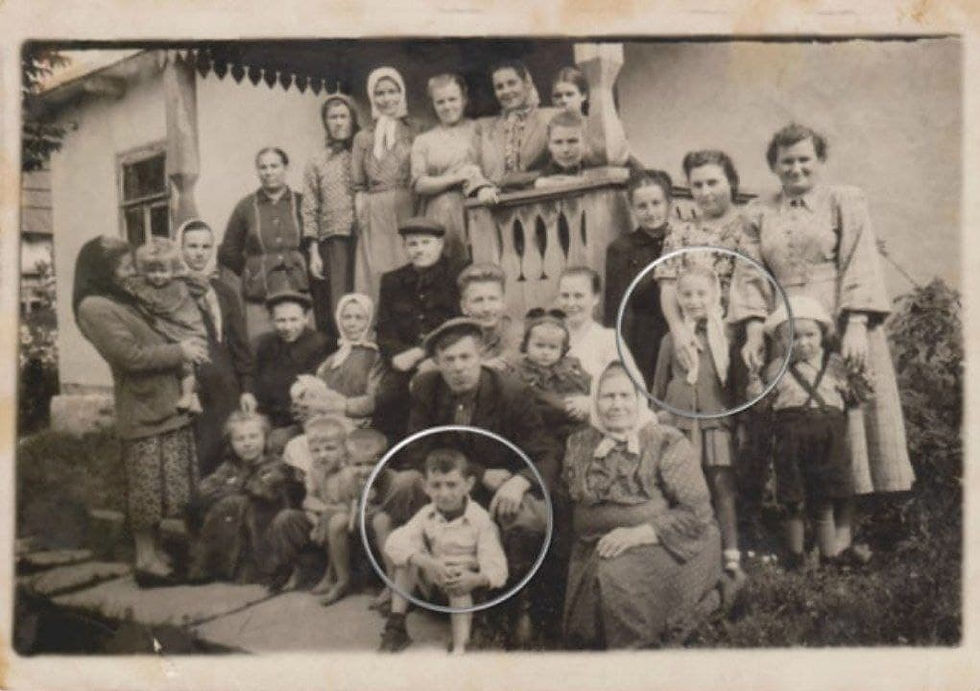
It is not known how, but after the war, Jews lived in Derazhne until the 50s. Subsequently, according to local residents, they went to the Vinnytsia region to visit relatives. Here you can see the photo from the personal archive of Tamara Voitovych. It depicts the farewell of the locals to the Jewish children Sima and Silva, who went to relatives in Vinnytsia. Their future fate is unknown.
Text and chart: Kateryna Kryvko Translation: Solomiia Kotiai


Comments